
Why Self-Expression Matters in Relationships
When we find ourselves at a relationship crossroads, our first instinct is often to ask, ‘Should I stay or should I leave?’
Sacred Crossroads starts somewhere different. Rather than forcing our way to a decision, it invites us through six thresholds of consciousness. Each threshold helps us become more aware of ourselves, our relationships and the life that wants to emerge.
Each threshold prepares us, not simply to make a choice, but to make one of the most significant decisions of our lives more consciously.
Sacred Crossroads | Step 5
The Threshold of Expression
So, what happens after we begin to see ourselves and our relationships with clearer vision?
Sometimes, a clearer view can feel disorienting. Our questions may change. We move beyond simply asking what is wrong, who is responsible, or what needs to change.
Awareness allows us to recognise what is happening within and between us in the relationship. Responsibility asks us to own the patterns, choices, and ways of relating that belong solely to us.
Then comes another threshold: What do we do with what we now know?
If awareness allows us to see and responsibility allows us to acknowledge and accept, expression asks something deeper. It invites us to do something with what we are discovering.
Self-expression in relationships is not necessarily about finding the perfect words. It is more nuanced than that. It is the process of allowing ourselves to show up more fully in our own lives and relationships. It is the gradual return of parts of ourselves that may have grown quiet, invisible, or lost. And not to forget welcoming home parts we never really knew.
Because until we begin expressing who we truly are, we cannot know whether it is the relationship that no longer fits, or the version of ourselves we have been living within it. Only when the relationship begins to meet the more authentic expression of ourselves can we begin to discern whether it is capable of holding the life that is asking to emerge.
Expression Not Just Speech
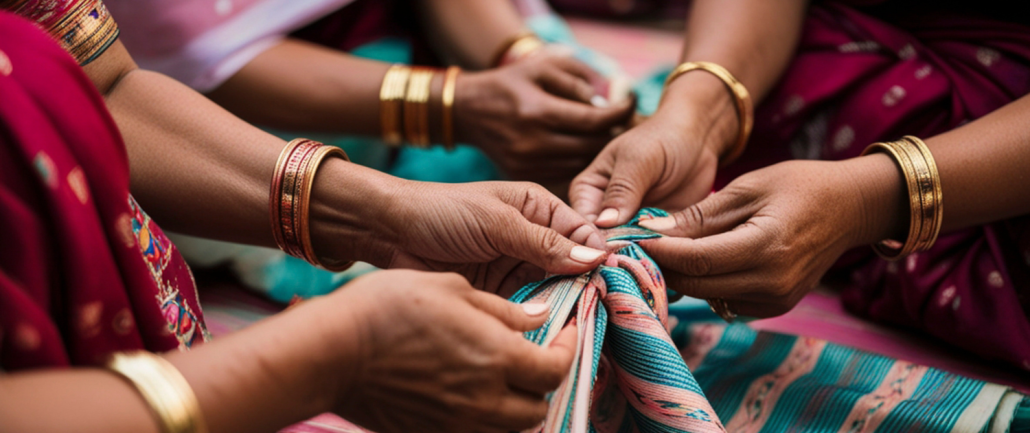
When we say self-expression in relationships isn’t just about speech, we can look to an ancient metaphor from Greek myth. In the story of Philomela, after she was violently stripped of her physical voice, she did not stop trying to communicate. Instead, she sat down at a loom. Thread by thread, colour by colour, she wove her inner experience into a tapestry. In this way, she tells her story in a form that could finally be heard and understood.
In some versions of the myth, Philomela transforms into a nightingale, finding a totally new voice. Her story reminds us that expression is not just about words. It can take many forms.
And if expression can take many forms, the next question becomes not just how we express ourselves, but what it is that we are expressing.
At a relationship crossroads, we are often emotionally overwhelmed. We may believe we are expressing ourselves honestly when, in reality, we are expressing fear, hurt or dysregulation. In those moments, what comes out may be real, but it may not yet reflect the deeper truth that is gradually emerging through awareness and responsibility.
Discernment & Expression
This is where discernment becomes important. The task is not to suppress our feelings or silence ourselves once again. Rather, it is to learn to distinguish between reactions organised by old wounds and the quieter wisdom that begins to emerge as those wounds are understood and integrated.
Sometimes this is difficult to do alone, particularly where there has been trauma. With the right support, expression becomes less about reacting to the past and more about giving authentic form to the person we are becoming.
Expression as the Return of the Whole Self
Self-expression in relationships, then, at its simplest, is the act of translating our inner world into words and actions. We see it when a musician speaks through an instrument, or an artist reveals themselves on a canvas.
In a relationship, it looks like giving voice to our needs, wants, and desires. It is how we share our vulnerabilities and our hidden interior landscapes. These are the moments where we begin to inhabit ourselves again. It is also how we express our hurt with care and respect for both ourselves and our partner.
Expression is not only about telling another person who we are. It is also about allowing ourselves to become more fully who we are.
For some, this process feels liberating. For others, it can feel deeply unsettling. Because beneath the desire to become more fully ourselves lies almost always a fear.
The Fear of Being More Fully Yourself.
If expression is so natural, why might we have resisted it?
At a relational crossroads, it is the underlying terror of disruption.
We spent years learning exactly how to behave to keep the relationship stable. But when those quieted parts begin to wake and ask to be expressed, it feels like an internal revolution.
We look at the person across from us and wonder: If I change the steps, will the dance fall apart? If I begin to speak my hidden needs, will it break the relationship, or will it save it?
The fear is that honesty will cost us connection. We worry that if we open the door to our true feelings, we won’t be able to control what rushes out: the built-up grief, the suppressed anger, or the desires we’ve hidden away. It feels safer to stay quiet, choosing the heavy but familiar comfort of being misunderstood over the vulnerable risk of being truly seen.
But staying at a relationship crossroads indefinitely can slowly wear you down. Expression, at this point, isn’t about throwing a hand grenade into the relationship to end it. It is about finally putting all the cards on the table so you can clearly see what you are actually deciding to stay in, or leave behind.
How Self-Expression Changes a Relationship
Because expression inevitably changes the relational system.
Relationships are living systems. When one person changes, the relationship inevitably changes because relationships are co-created.
Sometimes, when one person begins to express themselves, the relationship can deepen. There may be greater mutual honesty, more curiosity, and more opportunity for both people to know and understand each other.
At other times, new expression sheds a spotlight on the difficulties that were already lingering under the surface. A relationship that depended on one person remaining quieter may struggle when that person begins to speak. A dynamic in which one person’s needs consistently take priority may feel disrupted when greater balance is called for.
This is where responsibility becomes relational. Having recognised what belongs to us, expression invites us to bring that awareness into the relationship, not simply as insight, but as something that can be seen, spoken and lived.
With that in mind, a relationship may also be challenged when one partner takes up new hobbies or joins new friendship groups. This can feel threatening and bring up feelings of being abandoned. But this act of differentiation is important to the health of the relationship.
Allowing What Is True to Have a Place
Because one of the deepest forms of intimacy is allowing ourselves to be known. And that requires something from us.
It requires that we begin to show up, not as the version of ourselves we believe will or have been told is most acceptable, but as the person we are. And that requires trust. That we trust our partner can accept who we are and what is important to us. And that we want our partner to know us better. It also means that we can trust ourselves to emotionally risk saying what is on our mind and hold on to ourselves in the face of difficulties.
The Threshold of Expression is not about scripts and perfect speech. In fact, true self-expression in a relationship can be messy at times. One of the invitations of a relationship crossroads is allowing what is true to have a place.
When we no longer have to abandon ourselves in order to remain connected, something has the opportunity to begin to change. We begin to meet the relationship differently. And perhaps, more importantly, we begin to meet ourselves differently too. When we do that, then we begin to clarify with greater confidence the answer to the question: do I want to stay or do I want to leave?
Something to Consider
Of course, expression is never a one-way street. Just as we want to be understood, a relationship also asks us to make room for the experience, needs, and developing individuality of our partner. Maybe this is where sharing turns into dialogue, and where two people find out if they can keep growing not only as individuals, but together.
Sacred Crossroads
Relationship thresholds rarely arrive with total clarity. More often, they begin as a subtle feeling that something within the relationship, or within ourselves, cannot go on as before.
These are the kinds of thresholds explored in Sacred Crossroads, a reflective, depth-oriented process for those navigating periods of relational uncertainty, emotional transition, and psychological awakening.
Learning what it means to express ourselves more fully is often one of these thresholds. Not simply by speaking our truth, but by allowing our needs, values, creativity, vulnerability and emerging sense of self to find authentic expression within the relationship and in our lives.
The Sacred Crossroads is not about offering simple answers to whether you should stay or leave. Instead, it invites deeper questions about consciousness, relationship, identity, attachment, vitality, and the evolving forms of love across a lifetime.
Sometimes, the task is not to decide right away, but to learn how to stay in an honest relationship with what is emerging.
P.S. Pass It On
Have you enjoyed this post? Use the icons below to tweet, share on Facebook, and email them to specific friends. Join my email list for regular insights and tips on cultivating conscious relationships.
© Sandra Harewood 2026
About Sandra Harewood
Sandra Harewood is a registered Transpersonal Psychotherapeutic Counsellor, Couples Counsellor and Jungian Coach. Sandra is a specialist in working with women and couples facing crisis or at a crossroads in their marriage. Over the last 15+ years, Sandra has helped 100s of women and couples transform their lives and relationships. She has a private counselling and life-coaching practice in Pimlico and Bromley, South London. Sandra is passionate about helping couples create conscious relationships and put the soul back into their lives.


